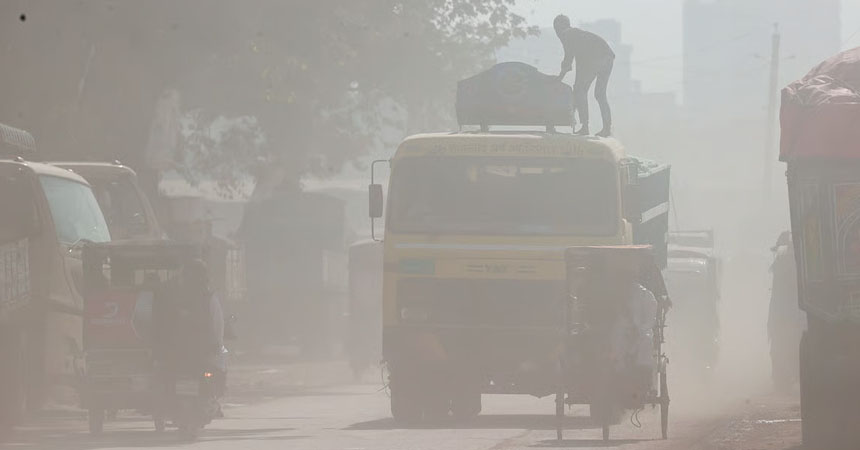
Environmental scientists and urban planning experts warn that should these trends persist, the ecological and residential appeal of these premier commercial and housing hubs will face severe long-term degradation.
Data recorded yesterday evening by IQAir—the Switzerland-based air technology metric platform—logged Dhaka’s overall Air Quality Index (AQI) score at 164, categorizing it firmly as "unhealthy." During this period, Dhaka ranked as the third most polluted metropolis globally, trailing behind Kuwait City and Kolkata.
Local observation nodes maintained by IQAir revealed that the highest pollution concentration within the capital was registered adjacent to the Bangladesh Institute of Development Studies (BIDS) in Agargaon, where the AQI metric reached 186.
(Note: Standard AQI scales classify scores of 0–50 as "Good," 51–100 as "Moderate," 101–150 as "Unhealthy for Sensitive Groups," 151–200 as "Unhealthy," 201–300 as "Very Unhealthy," and above 300 as "Hazardous.")
Geographical Microclimates and Urban Micro-Environments
Addressing the atmospheric retention over lake-adjacent upscale enclaves, Prof. Dr. Ahmad Kamruzzaman Majumder, Dean of the Faculty of Science and Chairman of the Department of Environmental Science at Stamford University Bangladesh, explained that local geographical microclimates exacerbate the crisis.
"The atmospheric moisture and water vapor hovering over urban lakes prevent particulate matter and exhaust soot from dispersing easily," Dr. Majumder observed. "These particles bind with water droplets, growing heavier and remaining trapped in the lower troposphere. During winter, temperature inversions compound this effect by placing a thermal lid of warm air over cold surface air, locking vehicular fumes and dust at ground level."
Complementing this perspective, Dr. Mohammad Enayet Hossain, Associate Professor at the Department of Soil, Water and Environment at Dhaka University, highlighted the structural role played by high-rise building density in Gulshan and Banani.
"The close placement of high-rise structures creates an 'urban canyon effect' that restricts natural wind corridors," Dr. Hossain noted. "When emissions from local traffic and adjacent informal settlements enter these architectural canyons, atmospheric flushing mechanisms are blunted, causing toxic fine particulates to settle near the breathing zone."
Structural Sources, Legal Enforcement, and Administrative Response
Stakeholders have identified private vehicle emissions and systemic construction dust as core drivers of the local degradation. Barrister Omar Sadat, President of the Gulshan Society, urged immediate legal crackdowns on unfit vehicles emitting toxic fumes. He stressed that a high volume of uncertified vehicles continues to ply city arteries, calling for strict enforcement by regulatory authorities and structural anti-corruption reforms within the Bangladesh Road Transport Authority (BRTA).
Regarding construction sites, civic leaders pointed out that while environmental codes mandate multi-tiered dust suppression curtains and water-sprinkling systems, real-world enforcement remains weak.
Shaukat Ali Bhuiyan (Dilon), President of the Banani Society, emphasized: "Extensive construction is underway across Gulshan and Banani. While advanced nations mandate strict multi-layered containment barriers, our existing environmental regulations suffer from weak field enforcement. Concurrently, environmental pressures stemming from Korail Slum must be mitigated by upgrading civic amenities, ensuring clean marketplaces, and banning municipal waste burning through strict city corporation directives."
Siddhartha Shankar Kundu, Deputy Secretary (Environment Pollution Control-1) at the Ministry of Environment, Forest and Climate Change, stated that official regulatory drives are ongoing under a dedicated inter-departmental committee. He noted that the committee’s upcoming sessions will conduct comprehensive reviews to institute upgraded enforcement protocols across the capital.