
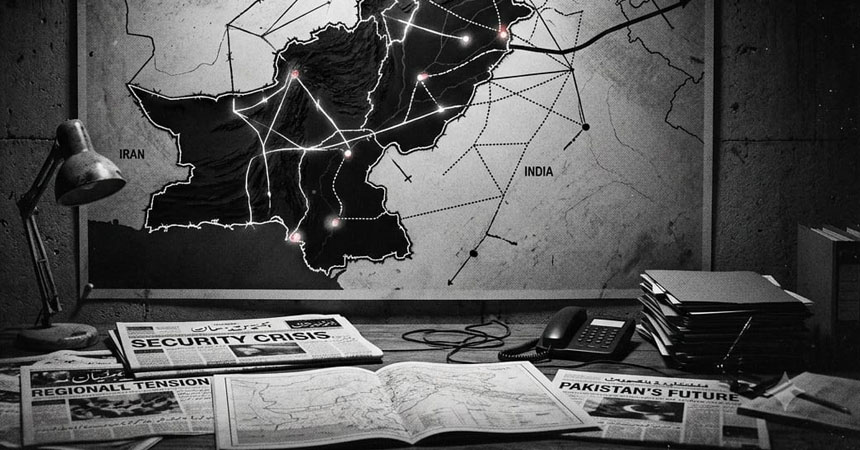
The remark triggered strong reactions, particularly in areas such as Khyber Pakhtunkhwa, where people have endured some of the worst consequences of militancy and terrorism for years.
The Punjab government later sought to clarify the statement, saying the chief minister was not referring to any particular province but to the movement of militants from one province to another.
But the underlying question goes far beyond the movement of militants across provincial boundaries.
The bigger question is this: How did extremist militant groups gain such strength in Pakistan in the first place?
A crisis rooted in state policy
A look at Pakistan’s history suggests that the roots of its present security crisis lie, at least in part, within the country’s own state policies.
For decades, Pakistan has pursued a selective approach towards armed groups—using some for strategic purposes while attempting to suppress others. Organisations such as Lashkar-e-Taiba and Jaish-e-Mohammed did not simply emerge overnight from the boundaries of a particular province. They developed over time within an environment shaped by state policy, geopolitical calculations and, according to numerous critics, varying degrees of official tolerance or support.
The use of armed extremist groups as instruments of geopolitical strategy has ultimately created a severe security challenge for Pakistan itself.
What may once have been viewed as a strategic tool has increasingly become a threat to the country's own citizens.
The limits of military solutions
Pakistan’s political history also demonstrates the limitations of relying solely on military force and coercive policies to resolve deep-rooted political and security crises.
The experience of 1971 remains a powerful historical example. Political and economic discrimination against Bengalis, followed by a devastating military crackdown, eventually culminated in the breakup of Pakistan and the emergence of Bangladesh.
The lesson of that history is difficult to ignore: no state can maintain lasting unity through force alone when political rights, public trust and accountable governance are absent.
Military operations may weaken militant organisations in the short term, but they cannot by themselves address the political, social and institutional conditions that allow extremism to survive.
Blaming provinces will not solve the crisis
Against this backdrop, holding neighbouring provinces or local populations responsible for Pakistan’s terrorism crisis offers little prospect of a lasting solution.
Khyber Pakhtunkhwa, in particular, has itself suffered enormously from militant violence. Many communities in the province have lost family members, homes and livelihoods as a result of terrorism.
Reducing the problem to the movement of militants from one province to another risks obscuring the deeper causes of extremism and insecurity.
Pakistan instead needs to examine how its past political and security policies contributed to the growth of militant networks and why those networks have proved so difficult to dismantle.
A political solution is essential
Addressing Pakistan’s terrorism crisis will require more than military operations or tighter security measures. It will require political dialogue, institutional accountability, equal citizenship and greater trust between the state and its people.
The country must also confront the contradictions of its past—particularly policies that differentiated between militant groups based on perceived strategic usefulness.
A sustainable counterterrorism strategy cannot be built on selective enforcement.
Pakistan’s current crisis therefore presents not only a security challenge but also a political one. Unless the country is willing to critically reassess its past policies and pursue a more inclusive political framework, the cycle of militancy and instability is likely to continue.
The central lesson from Pakistan’s own history is clear: lasting stability cannot be achieved through force alone. Political rights, trust, good governance and accountability are equally essential to building a secure and united state.