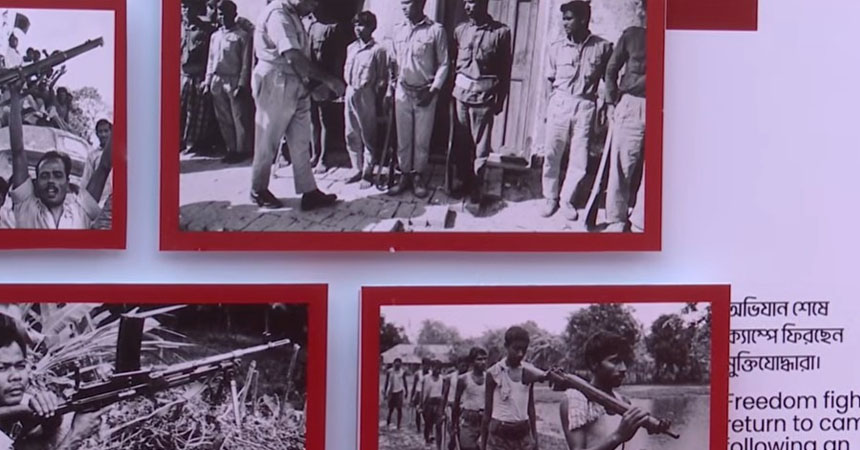
However, the exhibition does not feature photographs or information about Jamaat-e-Islami’s role during the 1971 Liberation War, when the party’s then leadership opposed Bangladesh’s independence and supported Pakistan, according to historical accounts.
The four-day exhibition, titled ‘July Is Not Over Yet’, was organised at the official residence of Jamaat Amir and Leader of the Opposition Dr Shafiqur Rahman on Minto Road in Dhaka. Discussions and criticism over the absence of Jamaat’s own wartime role were heard among visitors on the final day of the exhibition.
More than 100 photographs have been displayed, depicting various turning points in Bangladesh’s political history. The exhibition includes images of atrocities committed by the Pakistani military, as well as different moments from the Liberation War.
Photographs of the March 7 speech, various events during the Liberation War and Bangladesh’s victory in 1971 are also featured.
However, no photographs or information have been displayed regarding Jamaat’s position during the war or the controversial activities of its leaders at the time.
Critics have argued that the omission leaves out an important part of the political reality surrounding the Liberation War. They questioned why the activities of the Pakistani forces were included as part of history while the positions and roles of political forces active during the war were not presented.
The exhibition also presents Bangladesh’s post-independence political history from a particular political perspective.
The government of Bangabandhu Sheikh Mujibur Rahman is described as an “autocracy”, while the rule of HM Ershad is labelled “military dictatorship”. Sheikh Hasina’s tenure is described as “fascism”.
Notably, no photograph of former president Ziaur Rahman was displayed. Similarly, the governments of former prime minister Khaleda Zia and major political developments during her tenure were not presented through photographs.
Visitors expressed mixed reactions to the exhibition.
Foyez, a visitor from Mirpur, said, “If Jamaat distorts history, the conscious people of this country will also exclude them from history.”
Mushfika Tasnim, who visited the exhibition with her husband, said she was disappointed by some aspects of the presentation.
“Jamaat can better explain why these parts of history are missing from the photographs,” she said.
She, however, welcomed the inclusion of Sheikh Mujibur Rahman as part of the history of the Liberation War, saying the exhibition contained some important historical elements but did not provide a complete picture.
Asked why Jamaat’s role during the 1971 war was not included, Jamaat Assistant Secretary General Hamidur Rahman Azad said it was not possible to cover every event within the limited scope of an exhibition.
He said the exhibition primarily focused on the July uprising and that many historical events had therefore not been included. According to him, the organisers selected subjects that were relevant to the theme of the exhibition.
However, some people directly associated with the Liberation War said they were not satisfied with the explanation.
Bir Muktijoddha Ishtiaq Aziz Ulfat, president of the Jatiyatabadi Muktijoddha Dal, said Jamaat opposed Bangladesh’s independence during the Liberation War and sided with the Pakistani forces.
“During the Liberation War, Jamaat shot at us. They fought against Bangladesh. They did not want this country,” he said.
Referring to Jamaat as a defeated force of 1971, Ulfat also criticised the party’s present political position, claiming that its fundamental character had not changed despite receiving political opportunities on several occasions.
Muktijoddha and analyst Mofidul Haque said there was no scope for excluding the political realities of 1971 from the history of Bangladesh’s Liberation War.
He said the genocide committed in Bangladesh in 1971 was among the most devastating mass atrocities since the Second World War. Therefore, he argued, any presentation of the period should also address the positions of the political parties active at the time.
“Jamaat must make its position clear on the matter,” Mofidul Haque said.
He added that the genocide committed during the Liberation War remains a dark chapter in human history and that attempts by any political party to conceal or distort that history would be unacceptable.
The exhibition’s narrative presents Bangladesh’s political history through a series of political interpretations.
For 1947, it says: “Independence came, but the state did not change. The rise of the oppressive Ayub and Yahya Khan followed.”
For 1971, the narrative says: “The country became independent, but the state did not change. The rise of dictator Sheikh Mujib followed.”
The events of 1975 are described as: “Dictator Sheikh Mujib fell, but the state did not change.”
For 1990, the exhibition says: “The mass uprising brought down dictator Ershad, but the state did not change.”
For 2009, its narrative reads: “A new government came, but the state did not change. The rise of fascist Sheikh Hasina followed.”
The 2024 narrative states: “The July mass uprising took place. Fascist Hasina fell. Fascism again?”
At the end, under the heading ‘We Must Succeed, July Is Not Over Yet’, Jamaat presents its political interpretation of Bangladesh’s history as a history of an “unfinished revolution”.
According to Jamaat’s narrative, repeated movements and struggles created new hopes at different points in history, but authoritarianism returned because fundamental reforms to the state structure and Constitution were not carried out.
The party views the July 2024 mass uprising as an important opportunity to break that cycle.
The exhibition ends with a question for visitors: “Can we do it?”
However, the absence of Jamaat-e-Islami’s own role during the 1971 Liberation War has emerged as the most debated aspect of the exhibition, raising questions about the neutrality and completeness of a presentation that selects certain parts of Bangladesh’s history while leaving others out.