Prime Minister Tarique Rahman recently acknowledged the country’s power problems and spoke openly about the challenges facing the government. His remarks have been praised by many as an example of political transparency and accountability.
However, the debate has also taken a different turn in Parliament. Some comments have appeared to place the entire responsibility for the power crisis on the electricity minister.
That raises a basic question: how fair is it to blame a single minister for a crisis that involves a complex and long standing power system?
The electricity minister is certainly responsible for the ministry. But the minister does not operate the entire power sector alone. The ministry depends on technical officials, engineers, power generation companies, transmission agencies and distribution utilities for information and decisions.
A minister also works as part of the government team under the prime minister. Major decisions on power supply, fuel, transmission and distribution involve several agencies and layers of technical assessment.
Bangladesh’s power crisis therefore needs to be examined from a broader perspective.
A Crisis That Did Not Begin Overnight
The current government has been in office for only about seven months. It has inherited a power sector with years of structural problems.
Bangladesh has also seen rapid growth in electricity demand because of expanding industries, businesses and urbanisation. At the same time, the country’s transmission and distribution systems continue to face technical and infrastructure limitations.
These problems include ageing equipment, long distribution lines, manpower shortages, overloaded transformers and weaknesses in fault detection and repair.
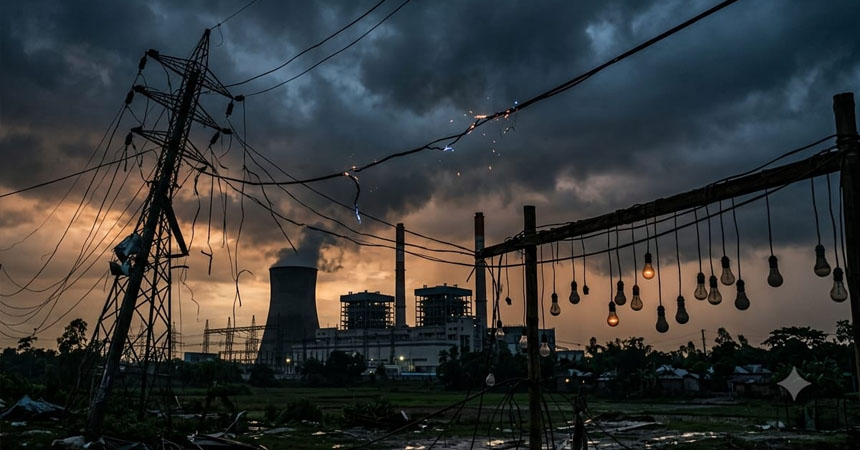
The situation becomes more difficult in rural areas, where electricity often travels through long overhead lines before reaching consumers.
In many cases, a single feeder has to supply electricity over a large area. When a fault occurs somewhere along the line, identifying the exact location can take considerable time.
Why Rural Areas Face Frequent Outages
Several factors can cause power interruptions in rural distribution networks.
Environmental conditions are one of them. Many rural power lines pass through areas with trees, farmland and open spaces. During storms or strong winds, branches can fall on power lines and cause short circuits.
Heavy rain, lightning and other extreme weather can also damage or trip equipment such as pin insulators and transformers.
Technical problems are another major factor.
Long feeders can cause voltage drops, particularly at the far end of a distribution line. The longer the distance from a substation, the greater the risk of voltage falling below the required level.
In some areas, limited use of modern protection and automatic reclosing systems can also turn a local fault into a wider outage.
If a fault occurs on a small section of a feeder, the entire feeder or even a substation may sometimes have to be shut down for safety.
Finding a Fault Can Take Hours
One of the biggest challenges in rural power distribution is locating a fault after a line trips.
Some rural feeders can extend for 30, 60 or even 80 to 90 kilometres or more. If a tree falls on the line, an insulator is damaged or another fault occurs, line workers may have to inspect a long stretch of the network before finding the problem.
The repair process can also take time.
Workers may need to remove branches, replace damaged insulators or repair other equipment. Only after the fault has been cleared can the line be re-energised.
In other words, restoring power is not always as simple as switching a line back on.
Growing Demand Is Adding Pressure
Electricity consumption in rural areas has increased significantly. As demand grows, distribution equipment faces greater pressure.
If a transformer carries a load above its capacity, it can overheat and trigger protective devices. This can interrupt the power supply.
Equipment failure creates another challenge, particularly in remote areas. Replacing a damaged transformer or other critical equipment may take time if spare equipment is not readily available.
For this reason, adequate stocks of transformers, insulators, fuses and other essential equipment are important for maintaining reliable electricity supply.
Manpower also matters. Areas with long feeders and large numbers of consumers need enough technical staff to identify and repair faults quickly.
Generation Is Only Part of the Problem
The national power generation and supply situation also affects rural consumers.
When fuel shortages or generation shortfalls reduce available electricity, pressure increases across the entire system. At the same time, areas such as Dhaka and major industrial zones often require priority supply because of their economic importance.
This can have a direct impact on rural distribution networks.
Therefore, the country’s current power crisis cannot be explained only by generation shortages. Transmission and distribution problems also play an important role.
Modern systems such as SCADA, automatic protection, reclosing technology and fault location equipment can help reduce the duration of outages. However, these technologies need to be expanded across the distribution network and supported by adequate technical capacity at the local level.
Should the Minister Take All the Blame?
The electricity minister certainly has political and administrative responsibility for the ministry. But holding one minister solely responsible for every power interruption risks oversimplifying a much larger problem.
If a village experiences several hours of an outage because a tree has fallen on a long feeder, the immediate cause may be a distribution problem rather than a ministerial decision.
Similarly, if a transformer fails and replacement equipment cannot reach a remote location quickly, the problem may involve logistics, equipment availability and local infrastructure.
These are technical and structural issues that require detailed examination.
That is why parliamentary discussions on the power crisis should focus on finding the real causes and practical solutions rather than making personal or sarcastic remarks against individual ministers.
Criticism of government policy is a normal and necessary part of parliamentary democracy. But criticism becomes less useful when it ignores the technical and structural factors behind a national crisis.
What Needs to Change?
The solution does not lie simply in building more power plants.
Bangladesh also needs to modernise its transmission and distribution networks.
Smart grid technology, automatic reclosers and fault location systems can help identify problems faster. This can reduce the need for lengthy manual inspections.
The authorities also need to build more substations and distribution facilities to reduce the pressure created by excessively long feeders.
Staffing should be based on the length of feeders and the number of consumers they serve. More technical workers are needed in areas where faults take longer to locate and repair.
Remote areas should also maintain sufficient stocks of transformers, insulators, fuses and other critical equipment. Regional emergency reserves could help speed up replacement when major equipment fails.
A Problem That Requires a Systemic Response
Bangladesh’s power crisis has developed through a combination of factors. Generation capacity, fuel supply, transmission infrastructure, distribution networks, equipment, manpower and rising demand all play a role.
The current government has inherited many of these challenges, and it will take time to address structural weaknesses in such a large sector.
The government should therefore be held accountable for its decisions and performance. But accountability should come through facts, technical assessments and measurable results.
Blaming a single minister for every aspect of a complex national power crisis may generate headlines, but it does little to solve the underlying problems.
What Bangladesh needs now is a serious assessment of the entire power system, followed by coordinated action to strengthen generation, transmission and distribution.
The real test is not who gets the blame. It is whether the government can ensure reliable and affordable electricity for consumers while fixing the weaknesses that have built up over many years.