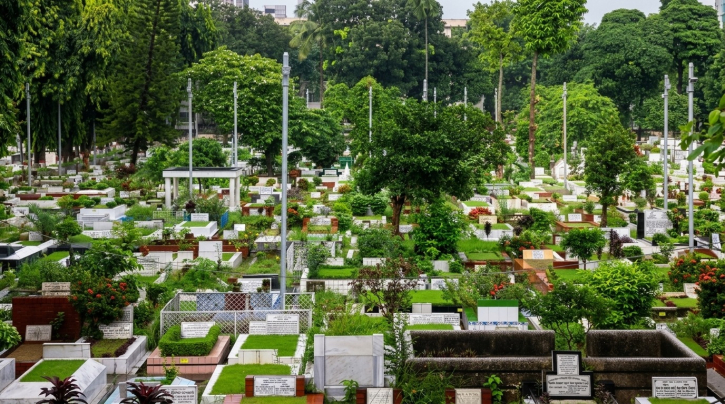
The capital has a limited number of public graveyards compared with its huge and growing population. As burial space becomes scarce, old graves are being reused after fixed periods, while long-term preservation is available only at substantial cost.
The contrast is particularly striking in Banani, one of Dhaka’s most affluent neighbourhoods. Recent reports say preserving a grave of about 20 square feet there for 25 years can cost around Tk4.5 crore, while a 15-year arrangement can cost about Tk3 crore in some cases.
That figure, however, is different from the official long-term preservation fee set by Dhaka North City Corporation under its 2022 graveyard policy. The policy, which took effect in January 2023, set the maximum preservation fee at Tk1 crore for 15 years and Tk1.5 crore for 25 years at Banani. DNCC said the sharp increase was intended partly to discourage people from reserving graves because doing so reduces space available for new burials.
The difference between the official preservation fee and the higher amounts reported in some cases points to a broader issue: the actual cost of securing and maintaining a grave can involve arrangements beyond the formal preservation charge.
A shortage of burial space
Dhaka’s graveyard crisis is fundamentally a land problem.
DNCC currently has six graveyards: Banani, Uttara Sector 4, Uttara Sector 12, Uttara Sector 14, Mirpur Shaheed Buddhijibi Cemetery and the cemetery beside the Rayerbazar Martyred Intellectuals Memorial. DSCC has three major public graveyards: Azimpur, Jurain and Khilgaon.
The available space is under constant pressure from new burials. At Banani, which has more than 9,000 graves, ordinary graves are reused after a fixed period because there is little scope to create additional burial space.
This means families who bury relatives in an ordinary grave may know that the grave will not necessarily remain intact indefinitely.
For those who can afford it, long-term preservation offers an alternative. But the cost varies widely between cemeteries.
Under DNCC's policy, preservation for 15 years costs Tk1 crore at Banani, Tk75 lakh at Uttara Sector 4, Tk50 lakh at Uttara Sector 12 and Tk30 lakh at Uttara Sector 14. At Mirpur Shaheed Buddhijibi Cemetery, the rates are Tk20 lakh for 15 years and Tk30 lakh for 25 years. At Rayerbazar, they are Tk10 lakh and Tk15 lakh respectively.
Under DSCC, long-term preservation is considerably cheaper. At Azimpur, Jurain and Khilgaon, the published rates are Tk5 lakh for 10 years, Tk10 lakh for 15 years, Tk15 lakh for 20 years and Tk20 lakh for 25 years.
When burial does not end the expense
The financial pressure can continue even after burial.
In Jurain, for example, the official registration fee for burial has been reported at Tk1,000 under earlier fee structures, with additional charges for digging the grave, bamboo and matting. A 2025 report said families sometimes paid substantially more than the prescribed amount, alleging that unofficial workers demanded additional money for burial-related services.
Such allegations include charges for putting up bamboo fencing, decorating graves, planting grass and regularly watering or maintaining them.
Some families have also reportedly been asked to pay monthly amounts to keep graves undisturbed or maintain their appearance.
These payments are not part of the formal preservation system, and allegations about unofficial collections would require verification by the relevant city corporation authorities.
DNCC's graveyard policy does not permit permanent structures or fencing over ordinary graves using bamboo, bricks, iron grills or other materials. This raises questions about how such informal practices continue in some cemeteries and who benefits from them.
Emotional cost of repeated burial
The shortage of space is not merely an administrative problem.
For families, a grave represents memory, identity and continuity. Many want to visit a loved one's grave years later, maintain it and keep the physical marker intact.
But in an ordinary grave, the limited lifespan of the burial space means the family may eventually have to accept that another person could be buried there.
The practice of reusing graves is a consequence of limited land rather than a new phenomenon. In a densely populated city, authorities have few options if burial demand continues to rise while cemetery land remains fixed.
In some reserved graves, multiple members of the same family can be buried over time. DNCC rules allow reburial of certain close relatives in reserved graves, subject to the applicable conditions and fees.
A widening economic divide
The system has also created a visible difference between families who can afford long-term preservation and those who cannot.
For a low- or middle-income family, paying hundreds or thousands of taka for burial may be manageable. Preserving the same grave for 15 or 25 years at millions of taka is an entirely different matter.
The result is a system in which the duration for which a family can retain a physical space for a deceased relative is closely connected to its financial capacity.
An example of this pressure can be seen in families who choose to take their relatives to ancestral villages for burial because preserving a grave in Dhaka is beyond their means.
For them, the choice is not simply between two burial locations. It can become a choice between keeping a loved one's grave close to the family and accepting the financial burden of doing so.
The crisis predates the current fees
The rising cost of grave preservation is part of a longer history.
In the 1990s, permanent grave plots at Banani and Uttara Sector 4 reportedly cost Tk1.2 lakh, while plots at Mirpur Shaheed Buddhijibi Cemetery were available for substantially less.
Permanent sales were later stopped for several years, and a time-based preservation system was introduced.
Before the major fee increase in 2023, preservation at Banani cost Tk24 lakh for 15 years and Tk45 lakh for 25 years. The new DNCC policy raised those rates to Tk1 crore and Tk1.5 crore respectively.
DNCC officials explained that the increase was intended to discourage long-term reservation rather than raise the cost of ordinary burial.
The logic is straightforward: if too many people reserve graves for decades, fewer spaces remain available for newly deceased residents.
A planning issue, not only a cemetery issue
Urban planners say the problem needs to be considered as part of Dhaka's broader land-use planning.
The city needs land not only for housing, roads, schools, hospitals, parks and commercial facilities, but also for burial grounds.
As Dhaka continues to expand, the number of residents who permanently live in the capital is likely to grow. For many of them, burial in Dhaka rather than in their ancestral villages could increasingly become the preferred option.
That could put further pressure on the existing cemeteries.
The challenge is therefore larger than the question of whether a family can afford a grave. It concerns how the city plans land for the final stage of its residents' lives.
What needs to change
The shortage cannot be solved simply by increasing preservation fees or reusing old graves.
A longer-term approach could include identifying new land for cemeteries, expanding existing facilities where possible, improving digital records, publishing all official fees clearly and strengthening monitoring to prevent unofficial collections.
The authorities also need to distinguish clearly between ordinary burial, time-bound preservation and reburial in reserved graves so families know exactly what they are paying for.
For a city of millions, burial grounds are not an optional part of urban infrastructure. They are a basic public service.
Dhaka's cemetery crisis shows the consequences of treating burial space as an afterthought in a city where every piece of land is under pressure.
For the living, the city's land shortage means expensive housing. For the dead, it increasingly means temporary resting places and, for those who can afford it, extremely expensive long-term preservation.
Ultimately, a grave is only a few feet of earth. But for a grieving family, it can represent an entire lifetime of memories.
The question for Dhaka is whether the city can ensure that those final few feet remain accessible not only to those who can pay millions, but also to ordinary families.