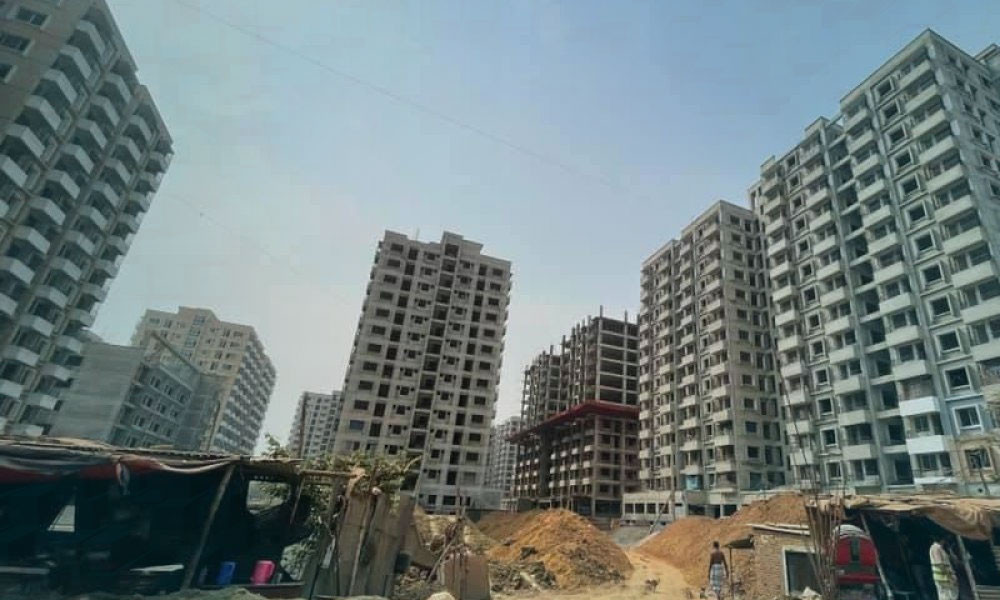
According to real estate industry estimates, roughly 20 million residents in Dhaka still do not own a home. Yet, despite this massive latent demand, sluggish sales have raised concerns over the sector’s trajectory. Economists and developers attribute the downturn to a convergence of macroeconomic pressures—including household income-expenditure imbalances, elevated home loan interest rates, surging construction costs, and heavy taxation and registration fees.
Contrary to widespread claims circulating on social media suggesting a sharp drop in land and apartment prices, market realities indicate otherwise. Developers note that residential unit prices have not declined significantly because raw material, labor, and financing expenses remain high.
Real estate entrepreneurs point out that persistent inflation has driven up essential household expenses—such as food, healthcare, education, and house rent—forcing many families to divert long-term home savings toward daily living costs or indefinitely defer property purchases. Compounding this is the high cost of borrowing; steep interest rates on home loans have deterred middle-income buyers unwilling to take on heavy monthly installment burdens.
Surging Construction Costs and Tax Pressures
On the supply side, escalating construction expenses have left developers with little room to lower prices. Industry data indicates that construction material costs rose by over 31 percent in the past year alone. Dr. Ali Afzal, President of the Real Estate and Housing Association of Bangladesh (REHAB), noted that overall construction costs have surged by approximately 43 percent. Over the past three years, residential apartment prices have climbed by up to 40 percent, reflecting sustained increases in land values, wages, and capital costs.
Fiscal measures have further strained the sector. The FY 2026–27 national budget introduced a fresh 15 percent capital gains tax on the government-assessed value of flats, while registration expenses in certain cases exceed 13 percent of the total property value. REHAB has repeatedly called upon the government to rationalize these tax and registration burdens to revive market momentum.
┌────────────────────────────────────────────────────────────────────────┐ │ REAL ESTATE & ALLIED SECTOR DOWNTURN AT A GLANCE │ ├────────────────────────────────────────────────────────────────────────┤ │ • Flat Sales & Bookings : Declined by 30% – 35% (Past 1 Year) │ │ • Overall Construction : Costs surged by ~43% (Materials up >31%) │ │ • Steel / Rod Sales : Dropped by up to 45% │ │ • Ceramic Product Demand : Declined by 20% – 30% │ │ • Electrical Equipment : Sales fell by up to 50% │ │ • Sector Defaulted Loans : Reached approximately 27% │ └────────────────────────────────────────────────────────────────────────┘Ripple Effects Across 269 Allied Industries
The real estate slump has triggered a severe ripple effect across 269 backward-linkage industries, including steel rods, cement, ceramics, glass, aluminum, timber, and electrical fittings. According to the Bangladesh Steel Manufacturers Association, rod sales have plummeted by up to 45 percent. Similarly, demand for ceramic products has fallen by 20 to 30 percent, while electrical equipment sales have dropped by as much as 50 percent.
REHAB estimates that approximately 5 million people are directly or indirectly employed across the housing and allied sectors, leaving millions of livelihoods vulnerable as project activities slow. Simultaneously, developers face mounting pressure in servicing bank liabilities, with industry reports indicating that non-performing loans (NPLs) in the real estate sector have climbed to roughly 27 percent.
Trust Deficit and Policy Recommendations
Beyond financial constraints, a deepening trust deficit has also deterred prospective buyers. Allegations of delayed apartment handovers and financial misappropriation by certain developers have made investors cautious. Analysts stress that lowering interest rates and taxes alone will not restore market vitality unless developers ensure transparency, accountability, and timely project delivery.
To break the stalemate, REHAB Senior Vice President Abdur Razzaq emphasized developing affordable housing zones outside Dhaka backed by improved transit connectivity and civic infrastructure.
Economist Shahadat Hossain Siddiqui warned that prolonged stagnation in construction and property sales could drag down broader macroeconomic growth, urging policymakers to introduce low-interest, long-term home mortgages alongside a dedicated refinancing fund for the housing sector. Without coordinated measures to ease borrowing costs, rationalize taxes, and rebuild buyer confidence, industry stakeholders warn that the stagnation in Bangladesh’s real estate market is likely to persist.