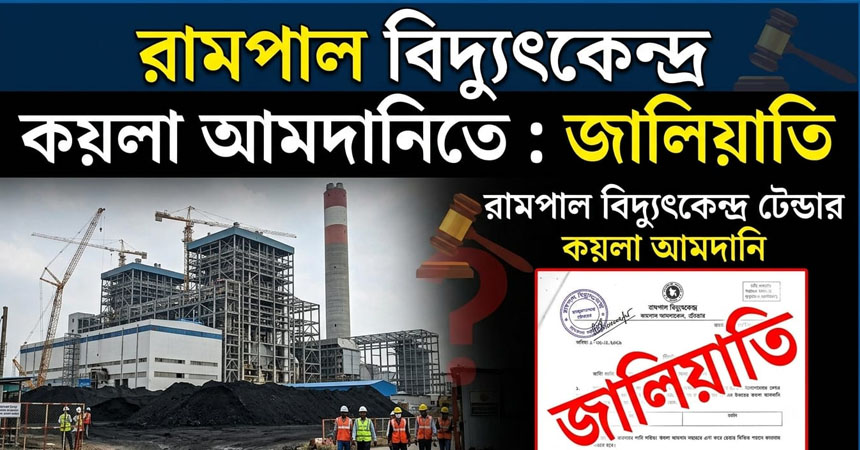
Industry sources allege that attempts are being made to give certain companies preferential treatment in the tender process for supplying coal to the power plant.
According to the sources, Singapore based Lianex and its business partners Mohit Minerals and Loshe Shipping participated in the Rampal tender by submitting what they allege are false or forged documents. The sources further claim that the documents were not properly disclosed or scrutinised and that an arrangement involving BIFPCL Chief Procurement Officer Zahidur Rahman was being used to facilitate the companies’ participation.
These allegations could not be independently verified.
The companies are also reportedly involved in supplying coal to the SS Power Plant in Banshkhali, Chattogram, according to industry sources.
Energy experts say Rampal has an important role to play in maintaining electricity generation amid ongoing pressure on the country's gas supply. They therefore stressed the need for all bidders in a major coal procurement process to be assessed through a transparent and equal process.
Questions have also been raised over the verification of documents submitted by bidders, including mine memorandums of understanding and other papers related to Indonesian coal mines.
Sources familiar with the power plant's procurement process claim that BIFPCL did not directly contact the relevant Indonesian mine authorities by email or through other independent channels to verify whether the submitted documents were genuine and whether the mines had the capacity to supply coal meeting the required specifications.
Such claims have not been independently established.
Energy expert Professor Shamsul Alam said documents submitted by a bidder and the production capacity of the relevant mine should be independently verified before the bidder is declared qualified.
“Showing a document alone does not establish the authenticity of the source,” he said, adding that weaknesses in the verification process could create risks for both coal supply and electricity generation.
Another energy expert, Professor M Tamim, said there should be no objection to a new company entering a competitive tender, but its eligibility should be assessed on the basis of independently verified experience, direct links with coal mines and proven supply capacity.
He stressed that procurement decisions involving national energy security should not be made without adequate verification.
Against the backdrop of the allegations, energy experts and industry stakeholders have called for an independent review of the ongoing tender evaluation process.
They said any evidence of favouritism, unequal treatment or inadequate verification of documents should be investigated. If serious irregularities are established, they suggested that the existing tender could be reviewed and, where warranted under procurement rules, a fresh and competitive tender process considered.
BIFPCL, however, rejected allegations of irregularities and favouritism.
Anwarul Azim, acting chief human resources officer of the Rampal power plant, said the evaluation process did not depend on any individual.
He said a competent and senior technical team was handling the process, leaving little scope for irregularities or favouritism.
The controversy comes as Bangladesh faces pressure on electricity generation and fuel supplies. Against this backdrop, stakeholders have called for coal procurement at Rampal to be conducted through a transparent, impartial and independently verifiable process, with national energy security and uninterrupted power generation taken into account.